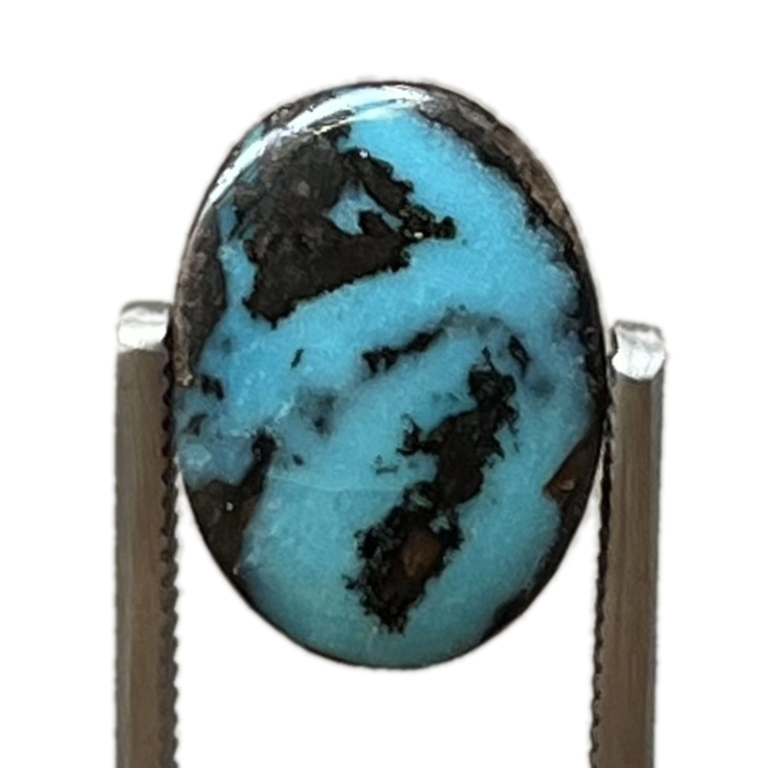
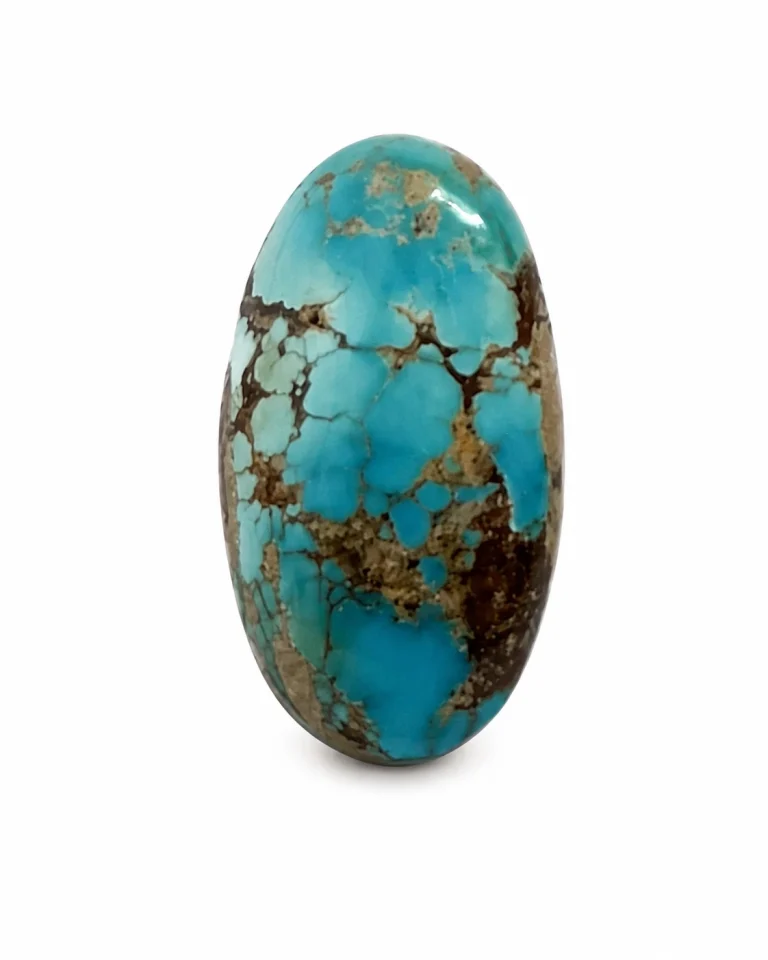
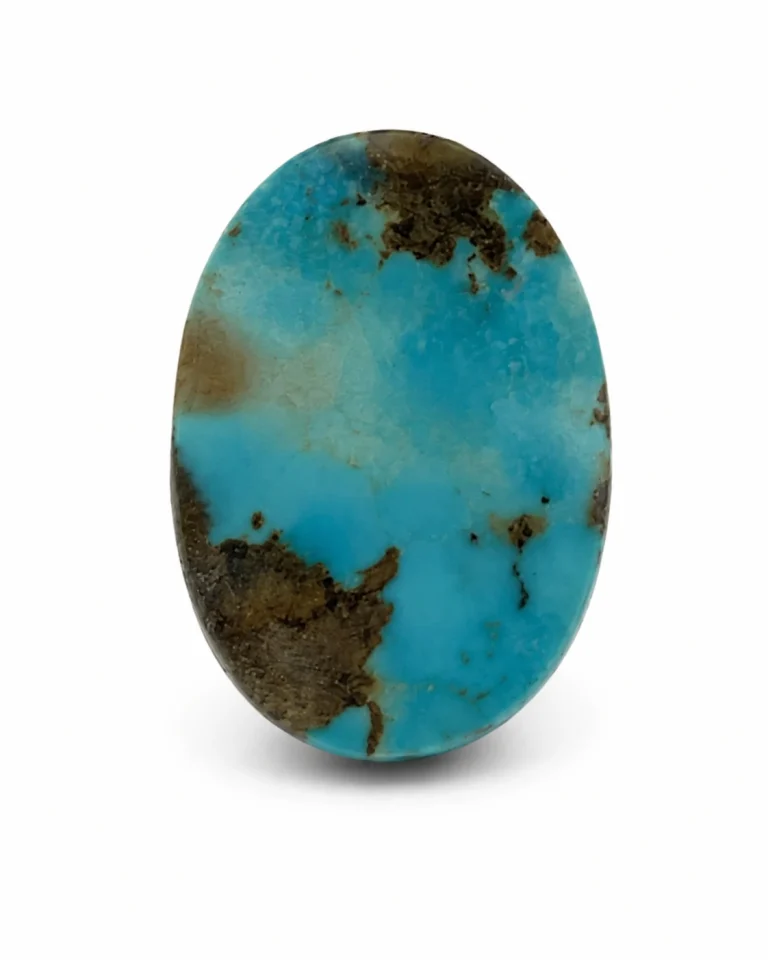
A turquoise cabochon is not only a colour choice. Its shape, profile, matrix, scale and documentary record all change how it can work in a jewellery project or a collection. Because a one-of-one stone cannot be replaced by an identical unit, the best starting point is to compare the whole object rather than a single photograph.
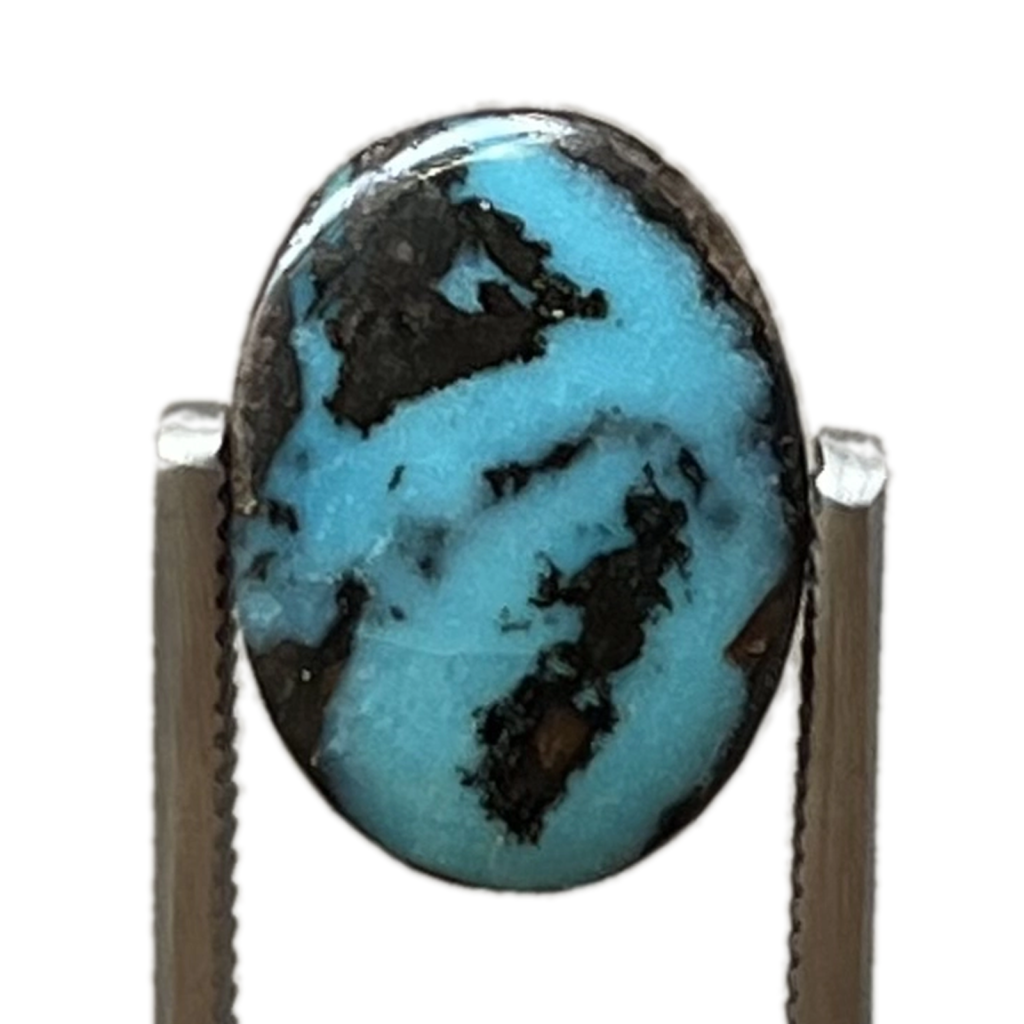
Start with the work the stone needs to do
For a ring, pendant, brooch or collector display, begin with the physical constraints: the available setting space, the desired visual direction and whether the stone should read as a calm field of colour or as a geological map. A sourcing brief becomes much more useful when it describes form, approximate dimensions, colour direction and matrix character instead of asking for a generic “blue turquoise.”
For design-specific context, read Neyshabur Turquoise for Jewellery Designers and compare the current Professional Sourcing route.
1. Shape: oval and elongated oval are not interchangeable
Oval cabochons are versatile because their length and width can sit naturally in many settings. An elongated oval creates a stronger directional line and may suit a vertical pendant, a narrow bezel or a design that needs movement along one axis. The decision should be made from the measured stone, not from the word “oval” alone.
- NEYFI 1030 is recorded as an oval measuring 20 × 14 × 5 mm.
- NEYFI 1024 is an elongated oval measuring 22 × 11 × 8 mm.
- NEYFI 1025 is an oval measuring 20 × 13 × 7 mm.
These measurements describe three different design geometries even before colour and matrix are considered.
2. Dome and profile: read the side view
The profile affects both the visual presence and the setting conversation. A low dome can sit closer to a surface; a higher dome creates more vertical presence and a stronger lens-like silhouette. The practical comparison is height relative to length and width, together with the setting constraints of the project.
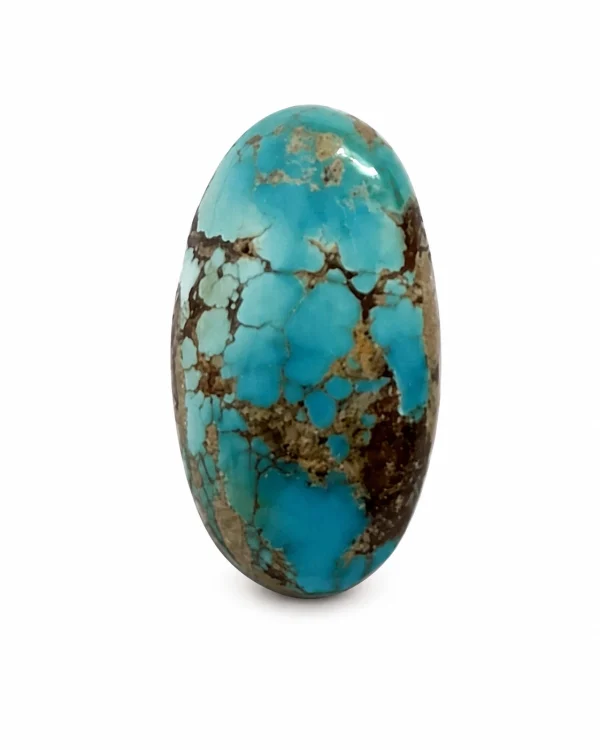
For contrast, NEYFI 1011 is recorded at 40 × 25 × 15 mm with a high-dome profile, while NEYFI 1030 is recorded as a low dome at 20 × 14 × 5 mm. Neither profile is automatically better: the correct choice depends on the work and the intended visual weight.
3. Matrix: treat the pattern as part of identity
Matrix is not a generic grade from light to dark. In a documented stone, it is a visible part of that particular specimen. NEYFI 1030 is recorded as bright blue-cyan with dark brown/black matrix-rich mixed character. NEYFI 1024 carries cream, grey and brown host-rock mosaic matrix. NEYFI 1025 is recorded with brown/black host-rock matrix.
Look at the front, reverse and profile views together. The distribution of colour, mineral islands and host rock can be more important to a design than a broad label such as “blue” or “green.” The guide Turquoise Matrix Patterns Explained gives the wider vocabulary without replacing the individual product record.
4. Scale: compare dimensions and weight, not appearance alone
Two stones can look similar in a card grid and behave very differently in a project. Compare measured length, width, thickness and carat weight. A compact stone may suit a small setting or a grouped composition; a larger stone may become the focal material of the work.
- NEYFI 1008: 16 × 9 × 5 mm and 6.65 ct.
- NEYFI 1030: 20 × 14 × 5 mm and 14 ct.
- NEYFI 1011: 40 × 25 × 15 mm and 87.20 ct.
Those are materially different scales. The right stone is the one whose geometry and presence fit the work, not necessarily the one with the largest number.
5. Use the documentary record as a buying checkpoint
Before choosing a natural turquoise cabochon, verify that the product page keeps the Stone ID, measurements, weight, origin, treatment statement, documentary images, EUR price and one-of-one stock context together. NEYFI product records describe the individual stone; a NEYFI record is not an independent gemological laboratory report, and any independent report is referenced only when one exists.
For the wider trust framework, read One-of-One Gemstones: Why Individual Stone Records Matter and How Turquoise Price Is Determined.
A short comparison checklist
- Confirm the intended setting or display context.
- Compare shape and measured dimensions.
- Read the profile and dome description.
- Study the matrix distribution across the documentary views.
- Check origin, treatment, Stone ID, EUR price and current availability.
- If the brief is specific, request a focused selection through Professional Sourcing.
Frequently asked questions
Is a more blue turquoise cabochon always the better choice?
No. Colour is one recorded attribute. Form, matrix, scale, setting requirements and the identity of the individual stone all matter.
Should I choose a flat or high-dome cabochon?
Choose from the project constraints and the desired visual presence. Compare the measured profile and the actual side view rather than relying on a category label.
Can NEYFI source a different size or matrix direction?
Yes. Send the intended dimensions, form, colour direction, matrix character and destination through the professional sourcing route so the available documented stones can be narrowed around a real brief.
To compare the current documented field before sending a brief, open المجموعات.
From the field notes
See the stones behind the material.
A field note is the beginning. Compare individual Neyshabur stones with their own documentary images, Stone IDs and EUR availability.