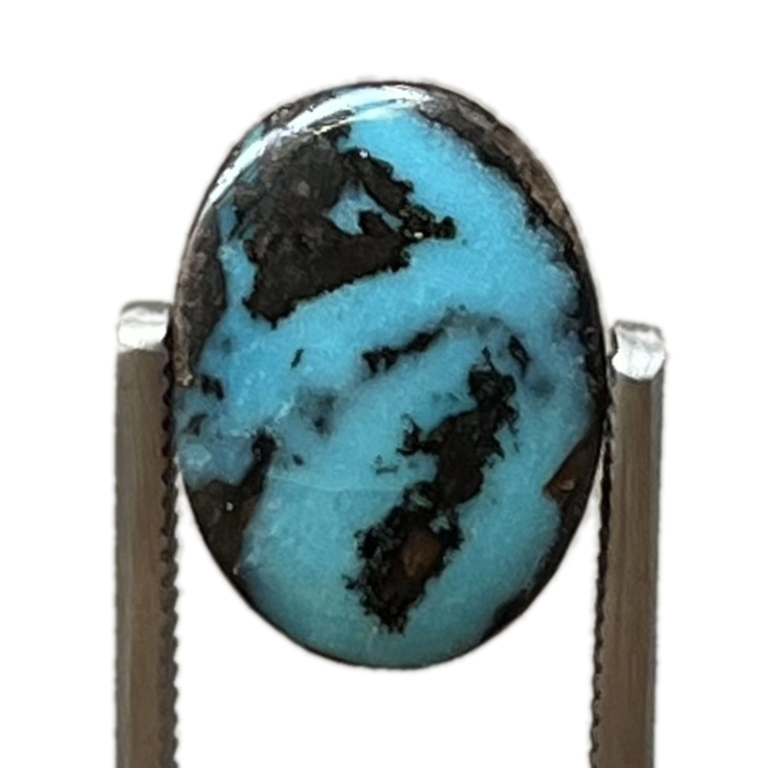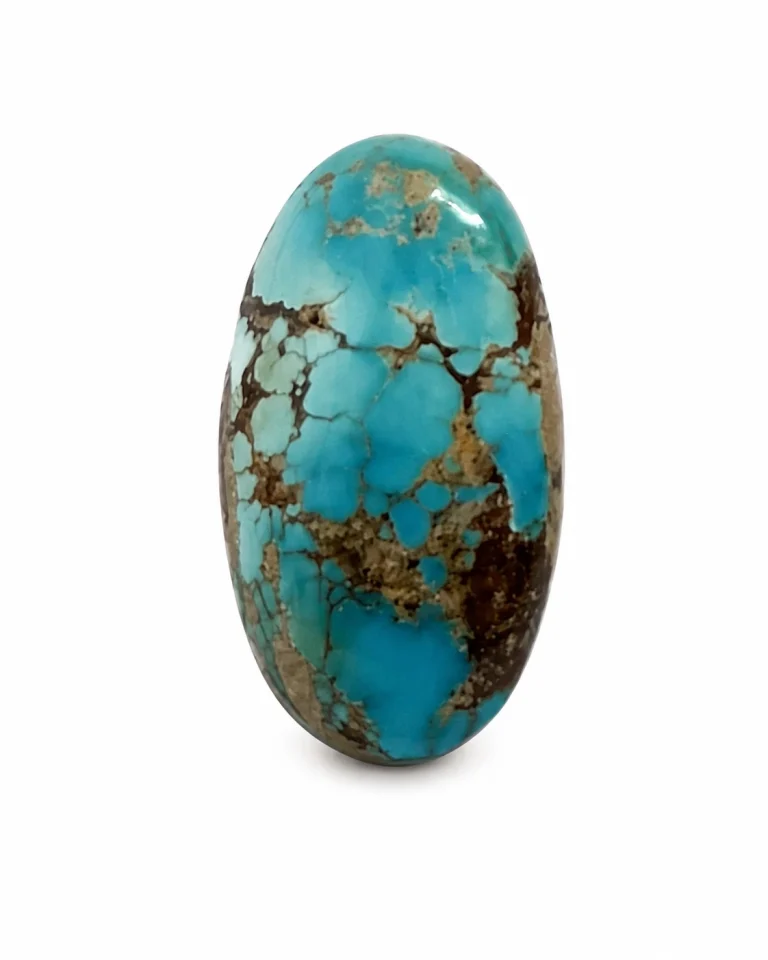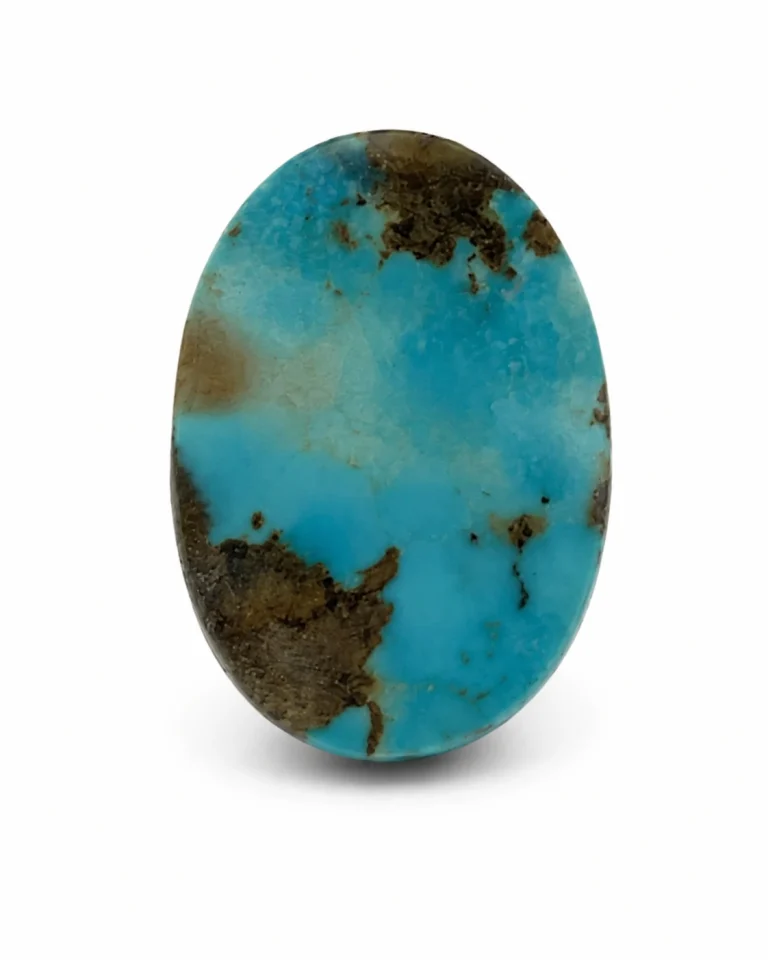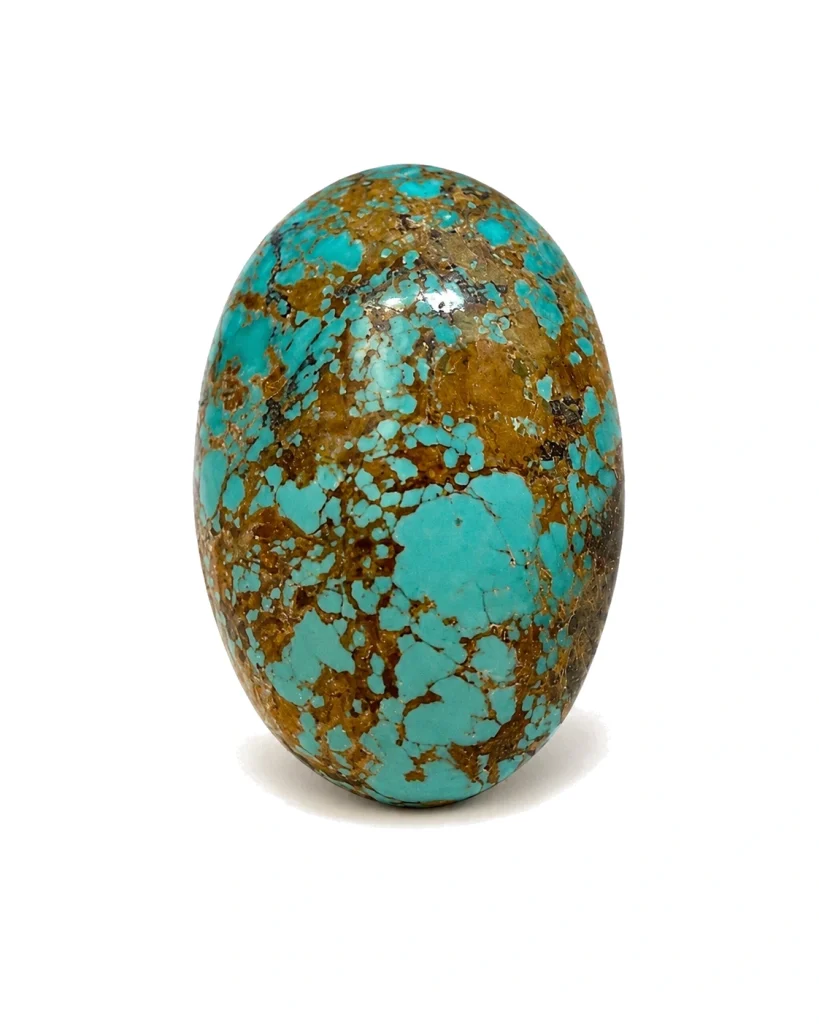
Turquoise does not have a universal price-per-carat formula. Two stones of similar weight can differ substantially in price because colour, matrix, treatment status, origin, form, surface quality, rarity, documentation and market preference all interact. For one-of-one stones, the object has to be evaluated as a whole.
NEYFI prices individual Natural / Untreated Neyshabur turquoise stones in EUR. The price shown on a product page applies to that exact stone and its recorded characteristics; it should not be read as a universal rate for all turquoise of similar weight.
Colour influences demand, but not by itself
Colour is one of the first things buyers notice. Saturated blue, blue-cyan, blue-green and greener turquoise can each attract different preferences. Historically and commercially, certain blue directions may command strong demand, but colour should not be isolated from the rest of the stone. A vivid field with poor surface integrity, an unsuitable form, or undisclosed treatment is not equivalent to a well-documented natural stone with strong overall character.
Matrix can add distinction or reduce demand
Matrix is not automatically a premium or a defect. Fine spiderweb, mosaic, brecciated, ribbon and host-rock structures can create highly distinctive stones, while some buyers prefer cleaner colour fields. What matters is the pattern’s visual quality, contrast, distribution and relationship to the turquoise body.
For a closer look at these structures, see Turquoise Matrix Patterns Explained.
Treatment disclosure matters
Turquoise may appear in the market in natural, stabilized, dyed, impregnated, reconstituted or imitation forms. These are not interchangeable categories. Clear treatment disclosure reduces uncertainty and allows buyers to compare like with like. A stone described as Natural / Untreated should be understood as a treatment statement for that specific object; it should not be confused with an independent laboratory report unless one is explicitly identified.
Origin can contribute to value
Geographic origin can matter when it is meaningful to collectors, designers or cultural history. Neyshabur turquoise has a long historical association with Persian turquoise, but an origin label alone does not determine quality or price. The individual stone still has to be assessed by its actual colour, matrix, dimensions, form, treatment disclosure and condition.
Size and weight matter differently
Larger stones can be rarer and may command more value, but weight alone is not enough. A deep stone can carry more carat weight without presenting a larger face. A thinner stone with a broad visual surface may be more useful for a pendant or ring. For jewellery designers, dimensions, dome and edge geometry often matter as much as total carat weight.
A documented example is NEYFI 1011, where 87.20 ct is meaningful only when read together with its 40 × 25 × 15 mm dimensions and high-dome profile.
For design-specific sourcing, read Neyshabur Turquoise for Jewellery Designers.
Form and cutting affect usability
A well-proportioned cabochon can be easier to set and may better reveal colour and matrix. Oval, elongated oval, teardrop and irregular forms each serve different design purposes. Symmetry can matter for some settings, while intentional asymmetry can be valuable in one-of-one work.
Documentation reduces uncertainty
In online gemstone buying, documentation has economic value because it reduces ambiguity. Exact weight, dimensions, multiple photographs, treatment disclosure, origin statement and a stable Stone ID make it easier to evaluate a specific object remotely. A documented one-of-one record also remains useful after purchase.
See One-of-One Gemstones: Why Individual Stone Records Matter for the archival role of Stone IDs and documentary photography.
Rarity is specific, not generic
“Rare” should refer to a specific combination of characteristics, not function as a blanket marketing label. An unusual size, exceptional colour, distinctive natural matrix, uncommon form, strong provenance or a particularly coherent combination of these factors can make one stone harder to replace than another.
Market context still matters
Gemstone prices are also shaped by demand, collector preference, design trends, currency, distribution and seller positioning. That means a historical sale, auction result or competitor listing can provide context without becoming a mechanical formula for another stone.
A practical checklist before comparing prices
- Compare treatment status before comparing price.
- Compare actual dimensions, not only carat weight.
- Look at front, reverse and profile images.
- Consider matrix as a visual characteristic, not a single grade.
- Check whether the origin statement is explicit.
- Confirm that the photographs show the exact stone being sold.
- Use a stable Stone ID or SKU when comparing records.
- Separate internal seller documentation from independent laboratory reports.
FAQ
Is turquoise priced by carat?
Carat weight is one factor, but there is no universal turquoise price-per-carat table that reliably captures colour, matrix, treatment, origin, form, rarity and market demand.
Is spiderweb turquoise always more expensive?
No. Spiderweb can be desirable, but the quality of the pattern, colour, treatment status, size and overall visual character still matter.
Does Neyshabur origin automatically make a stone valuable?
Origin can add historical and collector relevance, but the value of an individual stone still depends on its own observable and documented characteristics.
Compare currently available one-of-one NEYFI stones with live EUR pricing, Stone IDs and documented specifications.
From the field notes
See the stones behind the material.
A field note is the beginning. Compare individual Neyshabur stones with their own documentary images, Stone IDs and EUR availability.