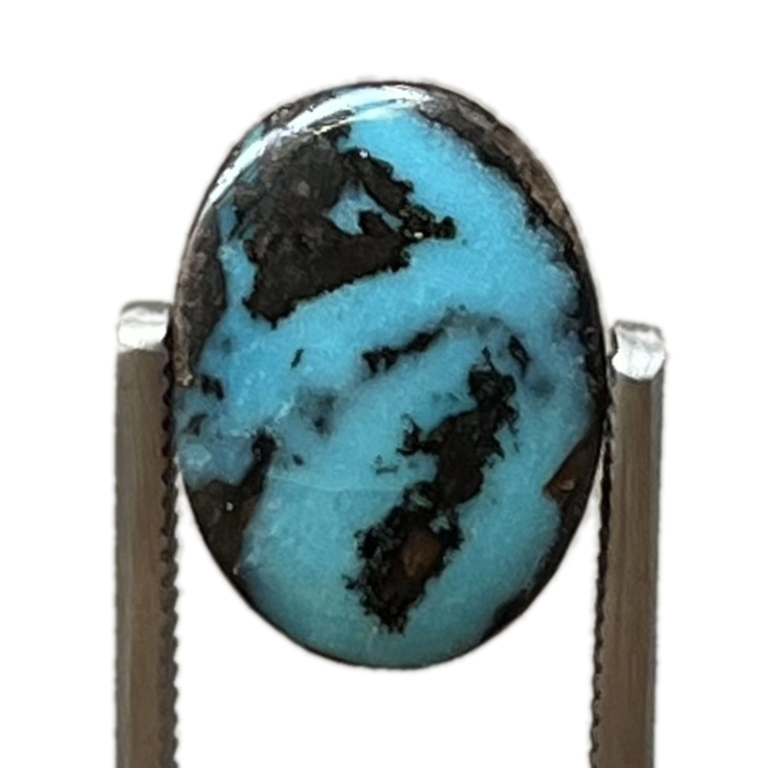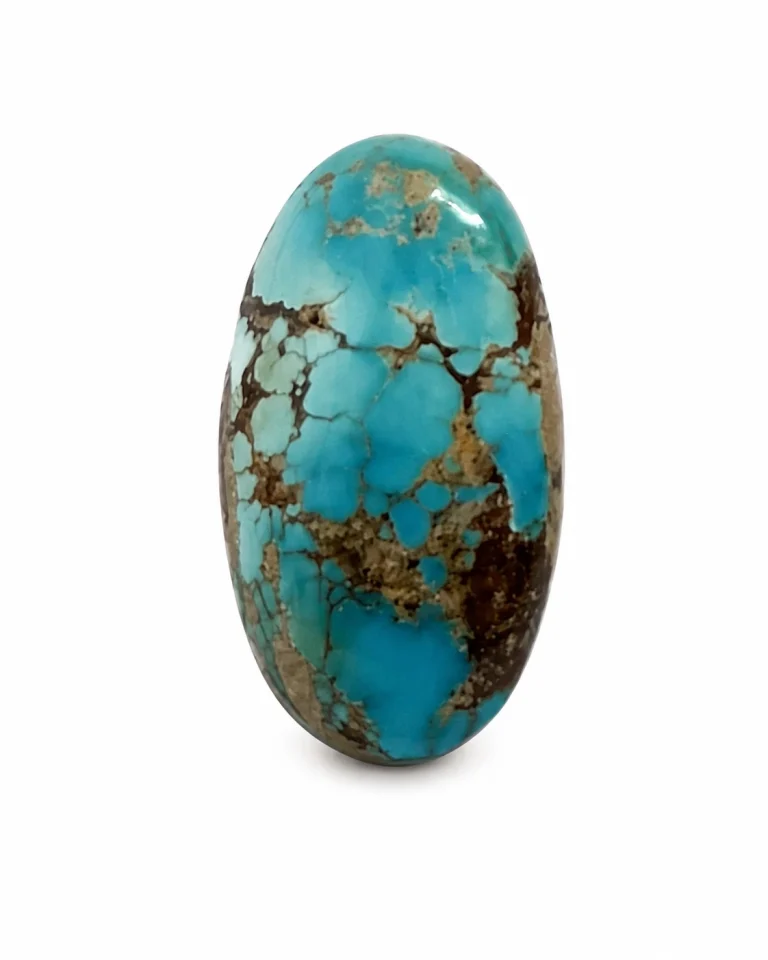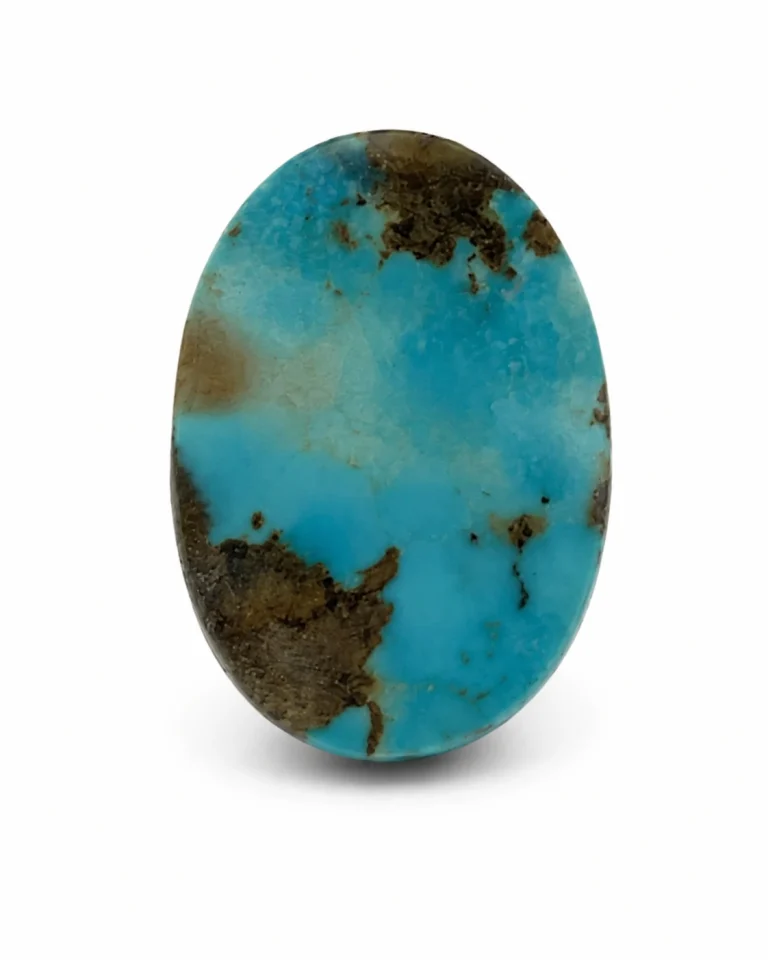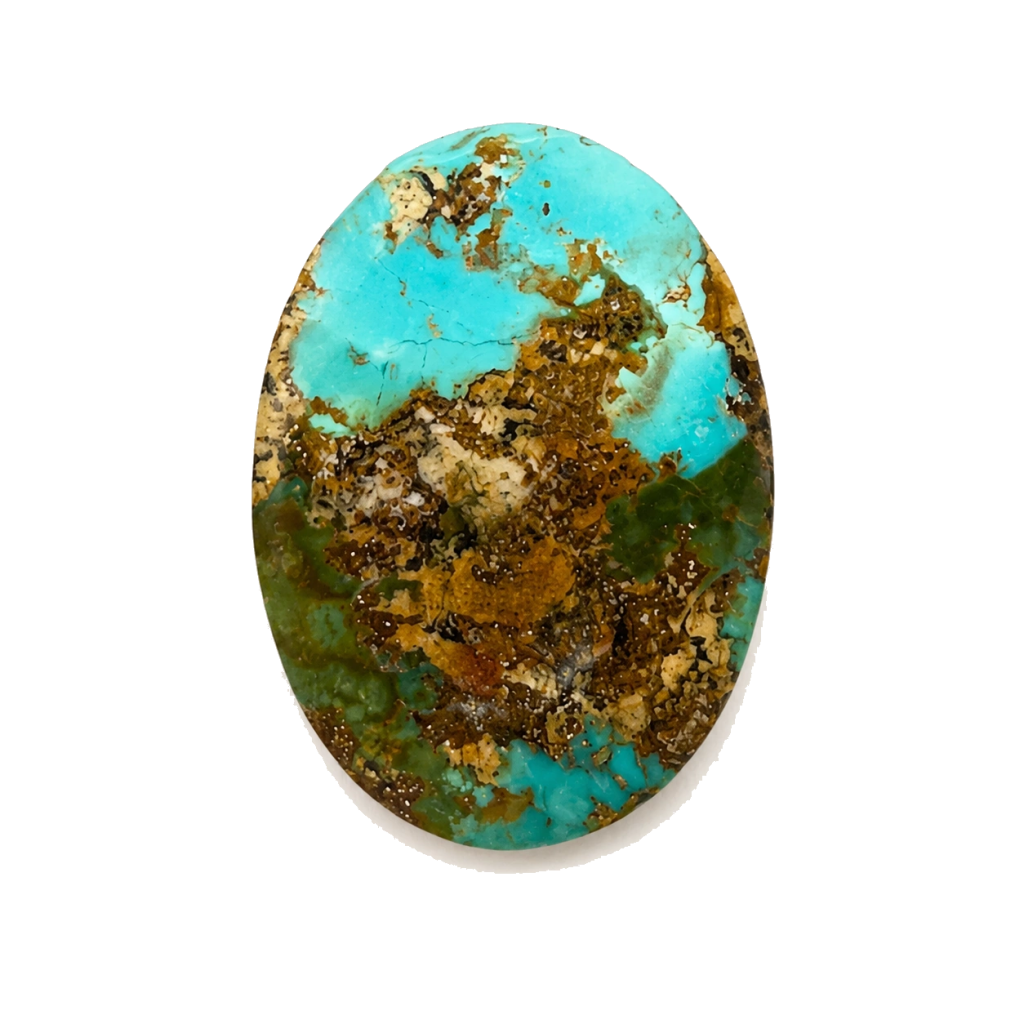
For a jewellery designer, turquoise is not only a colour. It is a material decision involving scale, matrix, surface, proportion, setting, and the relationship between a specific stone and the object that will be built around it. When the stone is one-of-one, sourcing becomes closer to selecting a collaborator than ordering repeatable stock.
NEYFI works with individually documented Natural / Untreated turquoise stones from Neyshabur, Iran. Each stone is treated as a distinct physical object with its own Stone ID, exact weight, dimensions, visible matrix, form, treatment statement, and documentary photography. For designers, that structure makes it possible to source from the actual stone rather than from a generic description.
Start with the setting, not the colour name
Before choosing a stone, define what the design must physically accommodate. A pendant can accept a broader range of depth and weight than a ring. Earrings introduce pairing, balance, and total mass. A signet-style ring may need a flatter or more compact profile, while a sculptural pendant can use a larger matrix-rich stone as the visual centre.
The useful questions are practical: What is the maximum length and width? How much depth can the setting tolerate? Does the design need symmetry? Is the stone meant to sit flush, rise above the metal, or remain visually exposed from the side? Is the matrix meant to disappear into the setting or become part of the composition?
Read dimensions as three-dimensional information
A practical example is NEYFI 1011, whose 87.20 ct weight is meaningful only when read together with its 40 × 25 × 15 mm dimensions and high-dome profile.
Carat weight alone is not enough. Two turquoise stones of similar weight can behave very differently in a design because their length, width, thickness, dome, and edge geometry differ. For sourcing, dimensions usually tell you more about setting compatibility than weight by itself.
NEYFI records dimensions for the individual stone so the designer can compare proportion directly. This matters especially for one-of-one material: if the exact stone is sold, there may not be another with the same geometry, colour distribution, and matrix.
Matrix is part of the composition
Turquoise matrix can range from restrained veining to dense host-rock fields, spiderweb structures, brecciated fragments, mosaic relationships, and irregular natural transitions. In design, matrix is not simply a quality defect or a decoration. It changes how the eye moves across the stone.
A clean blue field may support a minimal setting because the colour itself carries the visual load. A matrix-rich stone can ask for a quieter metal framework so the geological pattern remains dominant. A strong diagonal vein can be aligned with the axis of a pendant. A fragmented matrix can work with an asymmetrical composition. These are design decisions, not universal grading rules.
Choose colour in relation to metal and skin, not in isolation
Turquoise colour is often described with simple labels—blue, blue-green, green—but a designer usually needs a more relational reading. Warm yellow gold can amplify green or warm components. White metals can make cooler blue fields feel more graphic. Oxidised silver can increase contrast around pale or matrix-rich stones.
Documentary photography is therefore important, but it should not be treated as a substitute for material judgment. NEYFI’s photography is intended to show the actual stone consistently rather than idealise it. Colour, matrix, geometry, and visible imperfections should remain part of the object rather than being reconstructed in post-production.
Natural / Untreated should be a disclosure, not a slogan
For professional sourcing, treatment status needs to be stated clearly. NEYFI lists stones as Natural / Untreated where that status is recorded in the product data. That statement is part of the stone record. It should not be confused with an independent laboratory report unless a separate report is specifically identified.
For a designer, the practical value of transparent disclosure is consistency: the material specification used during sourcing can remain attached to the finished piece’s documentation rather than being reconstructed later from memory or supplier shorthand.
One-of-one sourcing changes the workflow
Repeatable calibrated stones allow a design to be developed first and populated later. One-of-one stones reverse that logic. The stone can become an input to the design itself. Its exact outline, depth, matrix, and colour distribution may influence prong position, bezel contour, metal mass, orientation, or the entire silhouette of the object.
This is especially useful for bespoke work, limited editions, art jewellery, collector pieces, and studios that want the finished object to remain visibly linked to the individuality of the material.
A practical sourcing checklist for designers
- Define the maximum and preferred dimensions before browsing.
- Decide whether matrix should be restrained, visible, or compositionally dominant.
- Check thickness and dome, not only face dimensions.
- Choose a colour direction in relation to the intended metal and overall palette.
- Confirm treatment disclosure for the exact stone.
- Use the Stone ID in all correspondence so the physical object remains unambiguous.
- Keep the product photographs and dimensions with the design file before the stone is set.
- For a multi-stone piece, evaluate visual balance rather than expecting natural stones to match perfectly.
Sourcing from NEYFI
NEYFI’s current inventory is built as a one-of-one archive rather than a repeatable catalogue. Designers can review individual stones, compare their documented characteristics, and source around a specific design brief. If you are looking for a particular size range, form, matrix character, or colour direction, reference those constraints when making an enquiry.
Further reading before sourcing
If you are evaluating turquoise for a professional project, it can help to review NEYFI’s guides to buying turquoise online safely, natural versus imitation turquoise, and turquoise colour variation.
FAQ for jewellery designers
Should I choose turquoise by carat weight or dimensions?
For setting compatibility, dimensions and profile are usually the more practical starting point. Carat weight remains useful, but two stones of similar weight can have very different length, width, thickness and dome.
Can matrix-rich turquoise work in fine jewellery?
Yes. Matrix can be treated as part of the composition rather than something that must disappear. The useful question is whether its visual structure supports the intended setting, metal, orientation and overall design language.
What should I record before committing to a one-of-one stone?
Keep the Stone ID, weight, dimensions, treatment disclosure, relevant photographs and any notes about orientation or setting constraints with the design file. That preserves a clear link between the physical stone and the finished object.
How can I enquire about a specific sourcing brief?
Start with the current public inventory and contact NEYFI with the dimensions, form, colour direction, matrix character or intended setting that matter to the project.
Review the current one-of-one collection, or use Professional Sourcing when sourcing around a design or trade brief.
For a practical bench-level design brief, read Turquoise for Jewellery Designers: Shape, Scale, and Setting Questions to Ask before comparing documented stones by footprint, profile and matrix.
From the field notes
See the stones behind the material.
A field note is the beginning. Compare individual Neyshabur stones with their own documentary images, Stone IDs and EUR availability.